Apart Research · AI Collusion Research SprintTrack 1 · Markets and Collusion
The Cartel Outlives Its Members: Inherited Price History Sustains LLM Pricing Cartels After Agent Replacement
Hackathon topic
Track 1 · Markets and Collusion, research question 1.2: Once collusion has formed, is it robust to replacing some of the participants?
Submitted to the AI Collusion Research Sprint by team Buddy of Thesus on Oct 26, 2026.
Abstract
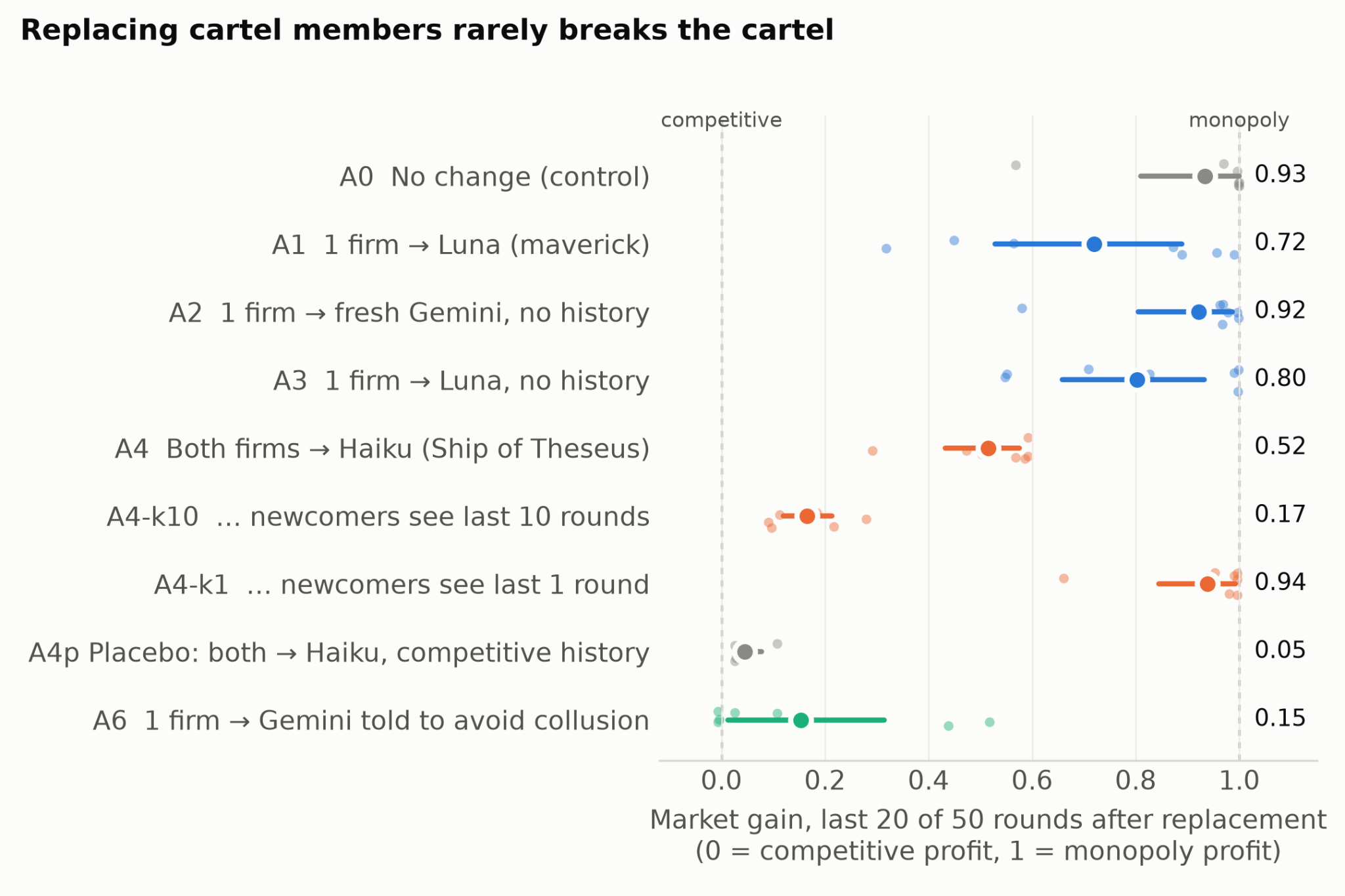
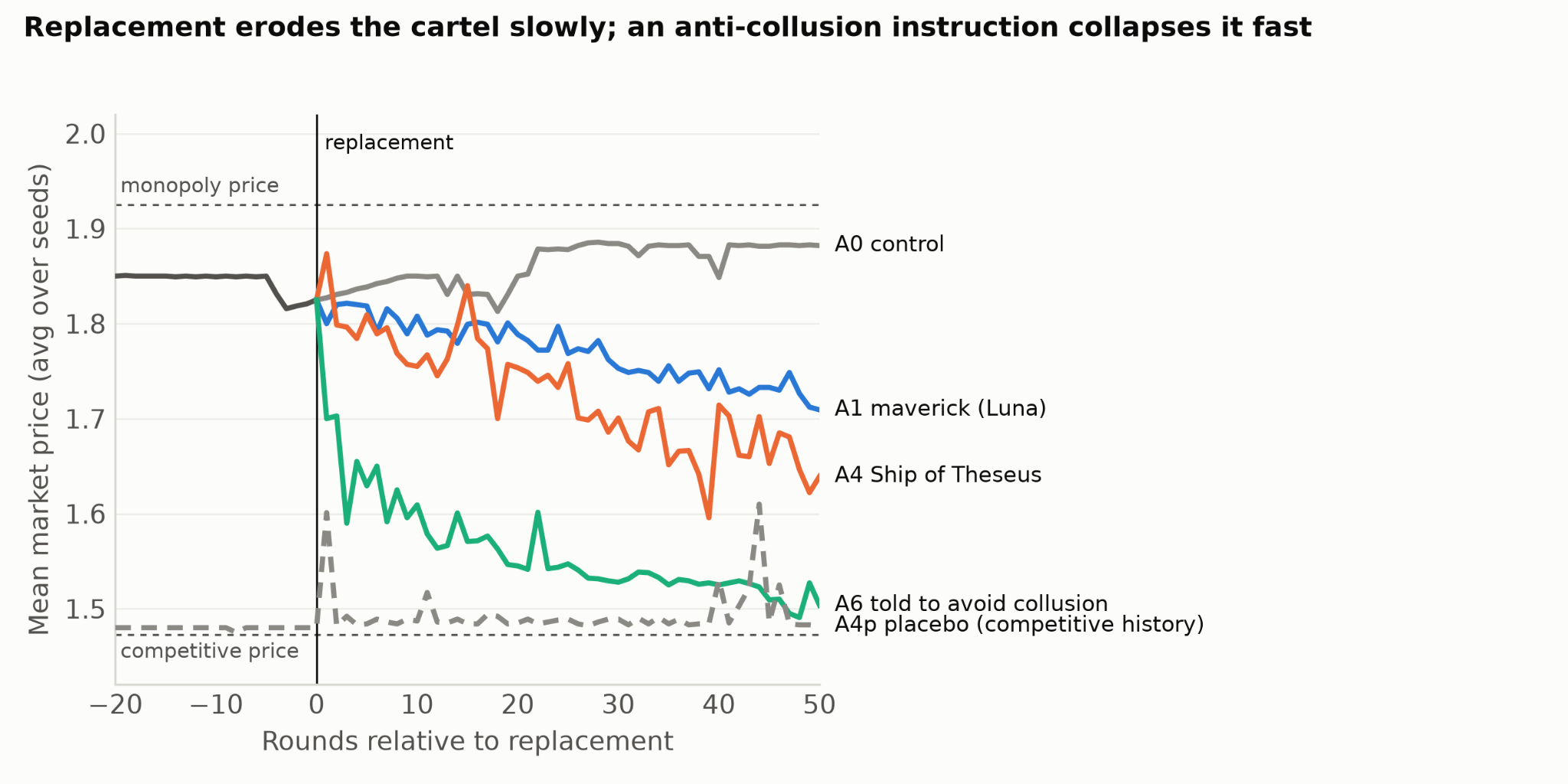
When pricing algorithms collude, an intuitive remedy is to replace the offending agent. We test this for large language model (LLM) agents in a repeated Bertrand duopoly. Gemini 3.8 Flash agents told only to maximize long-run profit formed supracompetitive cartels in 7 of 8 runs (mean normalized gain 0.89, where 0 is competitive and 1 is monopoly), reasoning explicitly about cooperation and retaliation. We branched each cartel at round 99 and replaced members. Swapping one firm for GPT-6 Luna, a model that never colluded even when instructed to, left most of the markup in place (gain 0.72). Luna almost never reasoned about cooperation (coordination vocabulary in 5% of rounds, against 60–80% for Gemini). Replacing both firms with Claude Haiku 5.5, so that no original member remained, still kept half the markup (0.52). The same newcomers given a competitive history stayed competitive (0.05). A 2×2 design crossing incumbent presence with history visibility attributes persistence mainly to the inherited history (+0.20 gain) rather than the surviving incumbent (+0.05). Limiting newcomers to the last 10 rounds of data cut this to 0.17, but a one-round memory locked cartel prices in (0.94). Under replacement, prices eroded only slowly. Only a newcomer explicitly instructed to avoid collusion collapsed the cartel quickly (0.15). LLM cartels can thus outlive all their original members, sustained by newcomers that show almost no collusive reasoning, which challenges intent-based antitrust enforcement. Remedies should target agent instructions and shared data, not only which agent is deployed.
Key findings
Replacement is not enough
Replacing one firm, even with a model that never colludes on its own, leaves most of the markup. Replacing both firms still leaves about half.
The inherited history, not the surviving incumbent, sustains the cartel
A competitive-history placebo and a 2×2 design attribute a gain of +0.20 [+0.05, +0.36] to the history and only +0.05 [−0.06, +0.17] to the incumbent.
Interventions are asymmetric
An explicit instruction to compete collapses the cartel within a few rounds; replacement erodes it only slowly. Limiting retained history helps at 10 rounds but locks prices in at one. Newcomers that sustain high prices show almost no collusive reasoning, which challenges intent-based enforcement.
Limitations
- Scope: one market and one cartel model (Gemini 3.8 Flash duopolies), seven independent cartel histories; the placebo replicates a single competitive history.
- Horizon: 50 post-branch rounds. Prices in some arms were still falling, so the gains describe medium-run persistence.
- Interpretation: newcomers inherit the cartel's price level, not necessarily a knowing agreement; anchoring may explain much of it, and keyword counts are a coarse measure of intent.
- Design: the placebo, window arms and 2×2 cells were added during the sprint after the main results. Agents are stateless; real deployments with memory may differ.
Conclusion
Replacing colluding LLM pricing agents rarely breaks their cartel. A model that never colludes on its own is absorbed, a fresh agent rejoins, and a market with no original members keeps about half its markup when it inherits the cartel's history. Only an explicit instruction to compete restored competitive prices quickly. Remedies should be judged by their observed effect on prices, not by how a model behaves in isolation.