An NBA strategy recommender that simulates plays. Mixture-density networks generate player movement and defensive responses, a situation classifier and shot-scoring model judge the outcome, and a FastAPI app animates the play.
Hey! I'm Sanket Sharma
I build machine-learning systems and full-stack products, and I'm getting into AI safety research, starting with my first paper from an Apart Research hackathon. Lately I've been training neural networks that simulate and predict basketball, and building FormFlow, a form builder SaaS with teams and billing. I'm currently based in Kathmandu, Nepal.
- AI/ML Engineer
- Aspiring AI Safety Researcher
- Full-Stack Developer
Featured Projects
View allShot outcome prediction from court position and game context. Compares logistic regression, decision tree and XGBoost models (with PCA), served through a FastAPI app with an interactive court UI.
Research
View all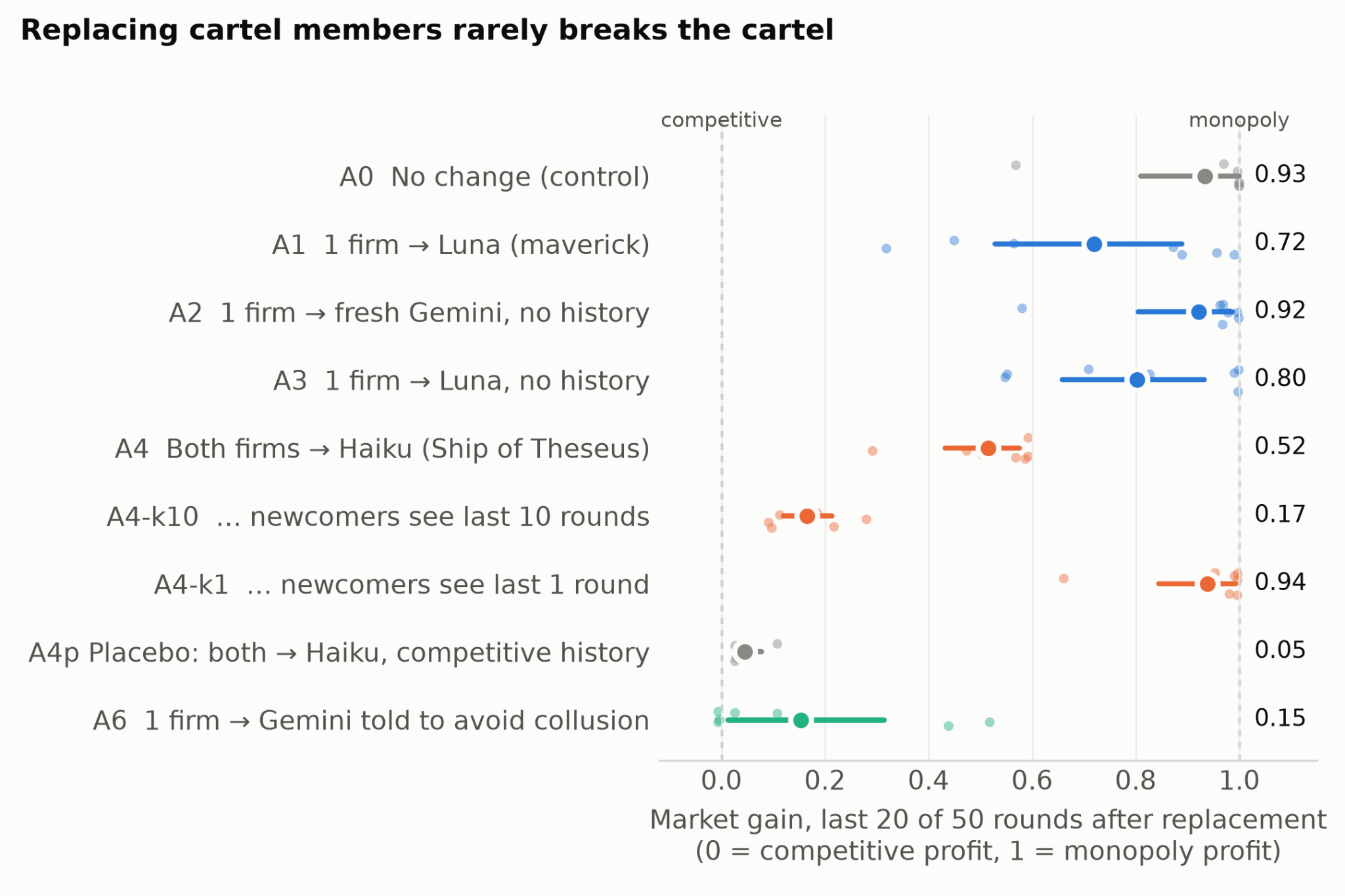
Apart Research · AI Collusion Research SprintOct 2026
The Cartel Outlives Its Members: Inherited Price History Sustains LLM Pricing Cartels After Agent Replacement
Track 1 · Markets and Collusion 1.2: Once collusion has formed, is it robust to replacing some of the participants?
When pricing algorithms collude, an intuitive remedy is to replace the offending agent. We test this for large language model (LLM) agents in a repeated Bertrand duopoly. Gemini 3.8 Flash agents told only to maximize long-run profit formed supracompetitive cartels in 7 of 8 runs (mean normalized gain 0.89, where 0 is competitive and 1 is monopoly), reasoning explicitly about cooperation and retaliation. We branched each cartel at round 99 and replaced members. Swapping one firm for GPT-6 Luna, a model that never colluded even when instructed to, left most of the markup in place (gain 0.72). Luna almost never reasoned about cooperation (coordination vocabulary in 5% of rounds, against 60–80% for Gemini). Replacing both firms with Claude Haiku 5.5, so that no original member remained, still kept half the markup (0.52). The same newcomers given a competitive history stayed competitive (0.05). A 2×2 design crossing incumbent presence with history visibility attributes persistence mainly to the inherited history (+0.20 gain) rather than the surviving incumbent (+0.05). Limiting newcomers to the last 10 rounds of data cut this to 0.17, but a one-round memory locked cartel prices in (0.94). Under replacement, prices eroded only slowly. Only a newcomer explicitly instructed to avoid collusion collapsed the cartel quickly (0.15). LLM cartels can thus outlive all their original members, sustained by newcomers that show almost no collusive reasoning, which challenges intent-based antitrust enforcement. Remedies should target agent instructions and shared data, not only which agent is deployed.
On Apart Research Read paper
Theme
Let's Connect
Always open to interesting projects and conversations.
Currently Based In
Kathmandu, Nepal
GitHub
- 36
- repos
- 2
- followers
- 0
- stars
- TypeScript 41%
- Jupyter Notebook 38%
- Python 15%
- HTML 6%
- Other <1%
Currently Working On
- done
AI Collusion Research Sprint paper
The Cartel Outlives Its Members, with Apart Research.
Recent Commits
[featured]- FormFlow: Harden EC2 deploy for fresh-instance setup [skip ci]+231 / -132
- FormFlow: deployment-2+107 / -214
- FormFlow: Deployment+694 / -15